



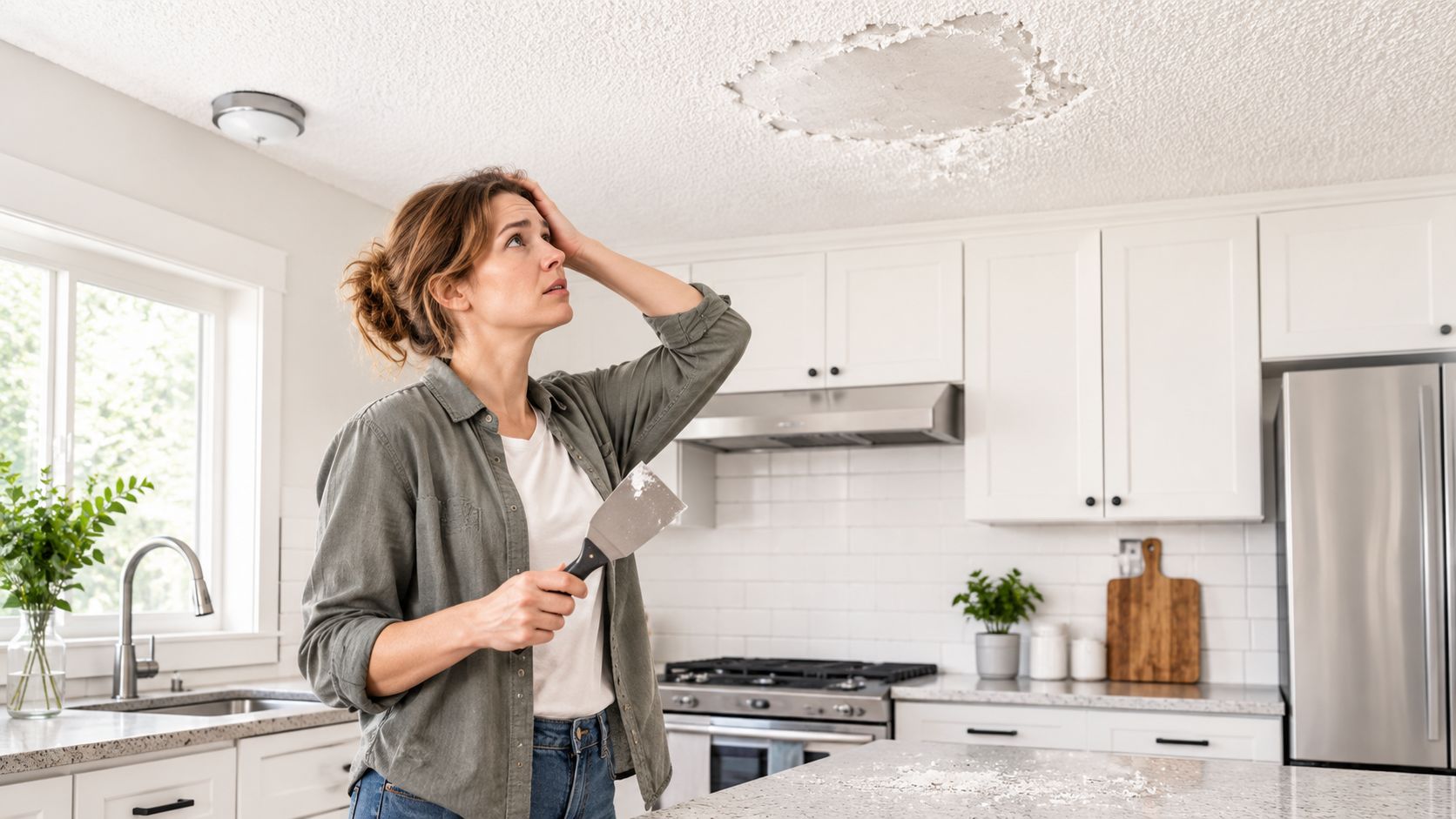
You scraped a bay of popcorn texture in your Beaverton kitchen, noticed white dust on the counter, and kept going with the putty knife. Now you're wondering whether you accidentally removed asbestos popcorn ceiling material, and whether cleaning up will make things worse. Put the knife down and leave the dust alone. The next job is controlling access and arranging professional testing, not finishing the ceiling.
Table of Contents
- What to Do in the First Hour
- Oregon and Washington Rules for This Ceiling
- How Sampling and Abatement Proceed
- Cost Timing and When Repair Can Start
- Papers to Keep Before You Reoccupy
- Rebuild the Ceiling After Clearance
What to Do in the First Hour
Treat scraped, sanded, or broken suspect texture as asbestos-containing until laboratory analysis establishes otherwise. Follow these actions in order, without stopping to finish a patch or collect your own sample.
Stop scraping, sanding, and patching. Leave the damaged edge alone. Don't knock off another piece to see what's underneath, and don't mix joint compound to cover the opening.
Move people, children, and pets out. Close the door and tell everyone the room is off limits. If the kitchen opens directly into other living areas, keep people away from the connected space and describe that layout when you call the inspector.
Shut off the furnace or air conditioner. Use controls outside the affected area if possible. Don't run fans to clear the dust or open up an airflow path through the house.
Don't sweep, dry-dust, or vacuum. A household vacuum or ordinary shop vacuum isn't an asbestos-cleanup system. Leave the floor, counters, and drop cloths untouched rather than trying to make the room presentable.
Leave tools, clothing, and drop cloths in the affected area. Don't carry dusty equipment through the house. If someone has already left, have them carefully change at the boundary of the affected area, bag the clothing without shaking it, and get handling instructions from the asbestos professional. Don't put it into the family laundry.
Don't start wet scraping or hang drywall over the debris. Adding water doesn't turn an uncontrolled disturbance into an abatement project. Fastening new board overhead also creates more disturbance before anyone has established what's there.
Write down what happened. Record the home's construction year if known, which surfaces were disturbed, approximately how much texture came down, who was present, and whether the HVAC was running. Tell other occupants that the room stays closed pending evaluation.
A partly scraped ceiling is a reason to stop, not an invitation to complete the bay.
Make the right first call
The Environmental Protection Agency's remodeling guidance recommends that damaged or renovation-disturbed suspect materials be sampled by a properly trained and accredited asbestos professional, with analysis by a qualified laboratory. Popcorn texture isn't the only concern. Textured paint, drywall joint compound, and taping compound may also need evaluation.
Don't ask a drywall installer to scrape a sample while quoting the repair. Tell the inspector that a disturbance has already occurred so the assessment addresses both the remaining ceiling and the affected area.
Keep the incident in perspective
The Consumer Product Safety Commission's asbestos guidance explains that appearance alone can't identify asbestos and that exposure risk involves factors including fiber concentration, duration, and frequency. A household incident isn't proof that future disease is inevitable, but it isn't something to dismiss because the dust looks ordinary.
Your immediate target is a closed room and an accredited assessment, not a finished ceiling that afternoon.
If you're concerned about a possible exposure, tell your healthcare professional what happened. A contractor can address the building problem, not diagnose your personal health risk.
Oregon and Washington Rules for This Ceiling
Oregon's owner-occupant survey exemption isn't permission to keep scraping. It addresses a survey requirement for a particular person doing particular work. It doesn't establish that the ceiling is asbestos-free or make contaminated debris ordinary household dust.
Under Oregon DEQ's homeowner asbestos guidance, residential buildings constructed before January 1, 2004 generally require an accredited inspector's asbestos survey before renovation or demolition, while commercial buildings require surveys regardless of construction date. An owner-occupant renovating inside their own single-family home is exempt from that survey requirement, although DEQ still recommends testing suspect materials before work.
DEQ treats renovation broadly. Altering, replacing, stripping, or repairing ceilings, walls, pipes, flooring, and insulation can fall within that category. Calling a job a ceiling patch rather than a remodel doesn't resolve the asbestos question.
Ownership and location change the paperwork
A landlord arranging a rental turnover in Portland isn't in the same position as an owner-occupant personally renovating their own house. Neither is a clinic owner repairing a ceiling in Beaverton or a contractor opening a Hillsboro ceiling after a leak.
Across the river, Washington Labor & Industries' asbestos guidance requires asbestos identification before work that could disturb it, allows an assumption that asbestos is present with the required precautions, and provides a mandatory fine of at least $250 for each violation when required inspection, written-assumption, or project-description requirements aren't met. Sprayed decorative coatings, including popcorn ceilings, are specifically identified as possible asbestos-containing materials.
Who must test after a popcorn ceiling is disturbed
| Situation | Survey or inspection | What must happen next |
|---|---|---|
| Oregon owner-occupant, own single-family home | Survey not required; DEQ still recommends testing | Stop work and sample suspect texture before more repair |
| Oregon older rental home or covered work by others | Accredited inspector survey generally required under the residential construction-date rule | Keep the survey on site; arrange licensed abatement for friable texture when required |
| Oregon commercial building, any age | Survey required regardless of construction date | Don't treat a small ceiling repair as exempt |
| Vancouver and other Washington projects | Good-faith inspection, or a written assumption that asbestos is present | Complete the required inspection or assumption and project description before work |
| Any untested scraped popcorn | Treat as asbestos-containing | No drywall cover-up, sweeping, or household vacuuming |
Small repairs can still disturb regulated material
Friable material can crumble under hand pressure and release fibers when disturbed. Don't test friability by squeezing a piece yourself. A damaged, crumbly ceiling belongs with the asbestos assessor and, where required, a licensed abatement contractor.
For property managers in Tigard, Lake Oswego, and Gresham, the practical issue is contractor coordination. Get the assessment into the project file before sending a painter, electrician, or drywall crew into the room.
Hiring someone else also changes the work arrangement. Don't assume an exemption for your own hands-on renovation automatically covers a contractor's subsequent work.
How Sampling and Abatement Proceed
Once the room is closed, the inspector needs an accurate account of the disturbance. Describe the scraped surfaces, dust locations, connected rooms, and any tools that were used. Don't enter again just to improve your photographs.
Professional containment separates the work area from occupied space.
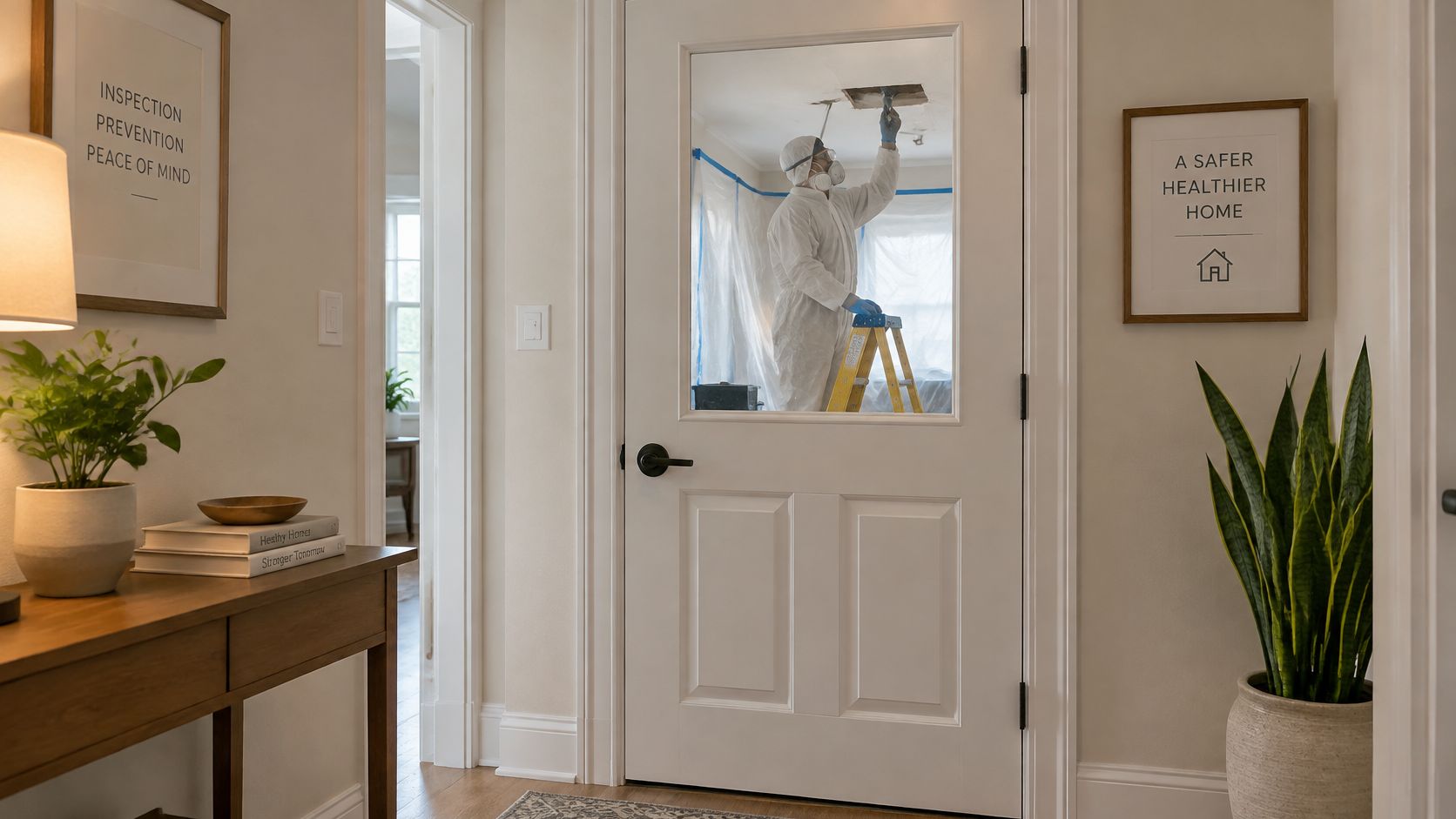
Sampling establishes the scope
An accredited inspector collects the samples because sampling can itself release fibers. The laboratory report establishes whether the sampled material contains asbestos; the inspector determines how those findings apply to the proposed work.
Make sure the assessment addresses the materials the renovation will disturb. A result for ceiling texture doesn't automatically identify the joint compound beneath it or a different textured coating nearby.
For property managers coordinating broader indoor-environment questions, the testing advice from Facility Management Insights is an additional planning resource. General indoor-air testing shouldn't be treated as a substitute for asbestos-specific material assessment or required clearance.
Confirmed asbestos needs a controlled plan
The OSHA construction asbestos standard specifies thorough wetting with amended water before and during regulated removal, intact removal where feasible, prompt placement of debris in leak-tight containers, and engineering controls such as isolation and HEPA-equipped local exhaust. That's a controlled work system, not a scraper and spray bottle.
From the homeowner's side of the door, the sequence should be clear:
- Define the work. The assessor and abatement contractor establish the affected materials, contaminated area, and removal or encapsulation approach.
- Handle notifications and containment. The responsible contractor coordinates applicable state or local requirements and establishes isolation and negative-air controls where required.
- Remove or encapsulate under the plan. Workers limit unnecessary breakage and package removed material promptly.
- Decontaminate and obtain clearance. Wet cleaning and properly rated HEPA equipment address debris and residue before the required release for reoccupancy.
Encapsulation can be appropriate when the professional assessment supports leaving material in place. It isn't the same as a handyman painting loose texture or screwing drywall over untested debris.
The video below provides additional context, but it isn't a homeowner removal procedure.
Don't undermine the containment
Household vacuums, dry sweeping, and sanding a patch edge can redistribute contamination. Wet cleanup materials also need controlled handling rather than being left to dry and then tossed into a household bin.
A clean-looking floor isn't evidence that the room has been released for normal use.
Keep unauthorized people out, leave the HVAC arrangements to the abatement plan, and retain the written scope. Waste handling must follow the applicable Oregon or Washington requirements, not assumptions based on ordinary construction debris.
Cost Timing and When Repair Can Start
Budget the ceiling in three bills: testing, abatement if it is confirmed, and the rebuild. A single "popcorn removal" quote hides two of them, which is why the cheapest line item on a positive-test ceiling is usually the one that never priced containment, regulated disposal, or the clearance visit.
The Spruce's 2024 popcorn-ceiling cost guide reported typical professional removal at approximately $900 to $2,500, with asbestos-containing ceiling work running more than $5,000. Treat those as broad reference figures rather than a Portland or Vancouver bid, and not as an all-inclusive allowance for replacement drywall, texture, and paint.
A confirmed positive changes the arithmetic, because containment, trained labor, decontamination, and regulated disposal are not ordinary ceiling preparation. Reconstruction then runs from a localized substrate patch to a full replacement ceiling, and nobody can finalize that estimate until the room is released and the board is visible.
The laboratory report gates everything downstream. Book sampling with turnaround in mind, since the abatement quote and the rebuild estimate both depend on the result, and a number written before that result usually carries an assumption you end up paying for.
Set dates by release points
The schedule that holds up names what must be finished before the next trade can start. Laboratory turnaround, contractor availability, notification requirements, and clearance all sit on that chain, so ask each party for project-specific dates rather than assuming the room reopens after a weekend. Clearance is a scheduled visit with its own cost, not a formality squeezed in at the end of a Friday.
Timing and cost from disturbance to a paintable ceiling
| Phase | Who handles it | Timing | Cost expectation |
|---|---|---|---|
| Contain the room | Household, stopping work without disturbing debris | Same day | No contractor fee for stopping work and restricting access |
| Sample and lab analysis | Accredited inspector and qualified laboratory | Confirm the sampling appointment and lab turnaround when booking | Quoted by sampling scope and laboratory service |
| Asbestos abatement | Licensed abatement contractor | After scheduling and any required notifications | Separate regulated-work quote |
| Clearance and reoccupancy | Parties named in the abatement plan | Before anyone resumes occupancy of the affected room | Confirm whether the clearance visit sits inside the abatement proposal |
| Non-asbestos popcorn removal | Remodeling crew after a laboratory report shows no asbestos in the sampled texture | Agreed project schedule | Ordinary-removal reference range above; get a local quote |
| New drywall, texture, and paint | Interior contractor after written clearance | After release of the work area | Separate reconstruction estimate |
Request the rebuild estimate without reopening the room
For Beaverton and Hillsboro homeowners planning the ceiling rebuild, request a free estimate from CS1 Real Interiors for post-clearance interior work. CS1 handles drywall repair, texture matching, and a paint-ready finish, and can price the rebuild from the abatement scope plus photos taken from outside the work area. Call an accredited asbestos professional first, then send the assessment and clearance status along with the request.
You can review drywall repair information while assembling the reconstruction scope.
Price the whole ceiling, not one phase
Read each proposal for the allowances it leaves out. Confirm whether the abatement quote includes the clearance visit and disposal fees, and whether the reconstruction quote covers primer and finish paint or stops at drywall. Ask what a change order costs when the crew finds damaged board, an old leak, or framing that has to move, then hold a contingency for it. A bid that names those items is usually the cheaper one by the time the ceiling is painted.
Papers to Keep Before You Reoccupy
Build a house file that explains what was disturbed, what was tested, what was done, and who released the room. Buyers, insurers, and property managers may later need that evidence. A paid invoice saying ceiling work isn't a substitute for a documented asbestos scope.
Photograph the closed work area and visible damage only from a safe location. Don't enter containment or handle debris to get a better record.
Keep the documents in working order
Sampling records and laboratory report. Retain the inspector's chain of custody and the report identifying each sample and its location. Keep the location descriptions with the results so a future contractor can distinguish the kitchen texture from another ceiling.
The Oregon survey for covered work. Keep the applicable accredited survey on site during the work, then save it permanently with the project records. Rentals, contractor-performed residential work subject to the construction-date rule, and commercial projects need particular attention.
Washington inspection or assumption documents. For Vancouver and other Washington projects, retain the good-faith inspection or written assumption that asbestos is present, together with the project description. Give the relevant information to subsequent contractors.
The abatement contract and work plan. These should identify the affected area, removal or encapsulation method, containment, waste packaging, and access restrictions. Save written scope changes too.
Waste documentation. Keep manifests or disposal receipts applicable to the job. The record should establish that the debris followed the asbestos-waste route rather than household trash collection.
Clearance and release records. Retain the written clearance or release documentation required by the project, including any applicable inspection or testing results and remaining restrictions. Confirm when occupants, children, and pets may return.
Don't demand a generic air-test certificate without understanding the plan. Ask the responsible asbestos professional to identify the required clearance method and the document that authorizes reoccupancy.
Feeling fine doesn't clear the room
CDC and ATSDR's asbestos respiratory-disease guidance reports that asbestos-related respiratory diseases commonly take 10 to 40 years or more to appear. That long latency explains why a symptom-free evening can't establish that cleanup was adequate.
It also doesn't diagnose the consequences of a household scrape. Keep the building decision and the medical question separate: the asbestos professional addresses contamination, while your healthcare professional addresses personal concerns.
Reoccupancy follows the documented release, not the room's odor or whether anyone feels well that night.
Give the next contractor a usable file
For a Lake Oswego rental, a Tigard clinic, or a Gresham shop, provide the relevant inspection and release records before booking interior work. If encapsulated material remains, identify its location and the restrictions on future disturbance.
Photograph or scan the paperwork and keep the original reports together. A painter covering a stain or a handyman mudding leftover texture doesn't replace those records, and cosmetic work can make the original condition harder to explain later.
Rebuild the Ceiling After Clearance
The release document sets the drywall schedule. No crew should be booking a start date before that paperwork exists, and if one offers to, that tells you how they handle the rest of the job. Once the affected area is released, the ceiling turns into an ordinary interior repair with an ordinary sequence: substrate, framing and rough-ins, board, finish, paint.
Start with the substrate. Check which board is sound, whether removal exposed framing, and whether plumbing or electrical access has been signed off before the ceiling closes. Where water damage caused the original failure, the source gets fixed first, then the drywall is repaired or replaced and finished ready for texture or paint.
Decide whether to blend or replace
A localized repair suits a sound surrounding ceiling where you want to keep the existing appearance. The work then lives or dies on the transition. The patch has to carry the same texture and the same paint sheen as the field around it, or it reads as a rectangle every time the light changes.
Go wider when the remaining surface is uneven, heavily damaged, or no longer the finish you want. On a smooth ceiling, settle Level 4 versus Level 5 before the first sheet goes up. Level 4 adds a coat of compound over tape and screws and sands the dried compound flat. Level 5 goes further, and under strong side lighting from a window or a row of cans the difference shows, so decide with the room's real lighting in mind.
- Retain the existing look. Mark the repair boundaries and agree on how new texture meets old.
- Change to smooth. Scope board prep, taping, finishing, primer, and paint together.
- Use an open ceiling sensibly. Finish approved framing, wiring, and insulation before hanging board.
Coordinate the interior work as one project
Ceiling repairs move faster when the trades share a schedule. Drywall, painting, insulation, and metal stud framing handled by one team means the texture match, the insulation going in ahead of new board, and the paint sheen get decided together instead of handed between crews. Matching orange peel, knockdown, and smooth textures keeps a patch invisible, and the crew setting a Level 5 finish can also hold a specified Level 4.
That covers homeowners, property managers, custom builders, and small commercial clients across Portland, Beaverton, Hillsboro, Tigard, Lake Oswego, Gresham, and Vancouver, WA.
Book with the ceiling scope defined
Bring photographs of the damaged area and your preferred final appearance to the estimate, and flag any asbestos-containing material left in place under a management or encapsulation plan so the proposed work leaves it undisturbed. The estimate should start from a defined, released area. Any further scraping belongs in an abatement scope with its own clearance test, and that belongs to a different contractor on a different day.
CS1 Real Interiors handles drywall repair, replacement ceilings, texture matching, insulation, metal stud framing, and interior painting after required asbestos work and clearance are complete. Visit CS1 Real Interiors to review the interior services, then request a free estimate through the contact form and include your clearance paperwork so the plan starts from a released ceiling.


