



A Level 5 drywall finish in the Portland metro typically costs about $2.75 to $4.50 per square foot. It’s a premium finish, and it makes the most sense when lighting, paint sheen, or resale expectations will expose every flaw in the wall.
If you’re planning a remodel in Portland, Beaverton, Lake Oswego, or Hillsboro, you’ve probably seen this happen: the drywall looks fine during construction, then the lights go in, the paint dries, and every seam, pinhole, and ripple suddenly shows up. Large windows, LED cans, wall washers, and smooth modern paint colors are unforgiving.
That’s where a Level 5 finish earns its keep. It isn’t just “better drywall.” It’s the highest standard of drywall finishing, built for walls and ceilings that need to look clean under tough lighting and close inspection. For some homes, that extra work is worth every dollar. For others, it’s more finish than the room needs.
The key question isn’t just what level 5 drywall finish cost looks like on paper. It’s whether the finish matches the room, the home, and the goal.
Table of Contents
- Your Guide to Flawless Walls in Portland
- What Is a Level 5 Finish and When Do You Need It
- Level 4 vs Level 5 Finish A Practical Comparison
- Breaking Down the Level 5 Finish Cost in Portland
- Sample Level 5 Project Estimates for Local Homes
- Hiring a Contractor for a Level 5 Finish
- Get a Flawless Finish for Your Portland Project
Your Guide to Flawless Walls in Portland
A lot of homeowners ask for smooth walls when what they really mean is walls that still look smooth after primer, paint, daylight, and night lighting all hit them at once. That’s a different standard than a typical paint-ready wall.
In Portland homes, the issue shows up most often in remodeled kitchens, primary suites, stairwells, and open-concept living areas with big windows. In newer homes around Bethany, Lake Oswego, and parts of Vancouver, WA, clean lines and modern fixtures make surface defects easier to see. In older homes, patchwork from past repairs can telegraph through paint unless the surface gets unified.
Why this matters before paint
A painter can improve a wall, but paint won’t hide finishing defects. Flat paint is forgiving. Higher sheen paint is not. Raking light from windows or accent fixtures is even less forgiving.
Practical rule: If the room has strong side lighting, glossy or semi-gloss paint, or a design goal that depends on clean smooth walls, standard finishing often won’t be enough.
A true Level 5 finish is built for that situation. It creates a more uniform surface across the entire wall instead of only treating the joints and fasteners. That difference is what separates “good from across the room” from “good up close.”
Where homeowners usually get tripped up
Comparing drywall bids by square foot is a common practice, but it often overlooks the underlying trade-offs. A lower bid may be based on a Level 4 finish, less prep, less masking, or less correction work after the first pass.
The better way to think about it is simple:
- If appearance is ordinary and paint is flat, you may not need Level 5.
- If appearance is a selling point, especially in a visible remodel, Level 5 often makes sense.
- If the walls already have repairs, texture transitions, or old damage, prep quality matters as much as the final skim.
That’s why level 5 drywall finish cost should be judged against the room’s visibility, not just the invoice total.
What Is a Level 5 Finish and When Do You Need It
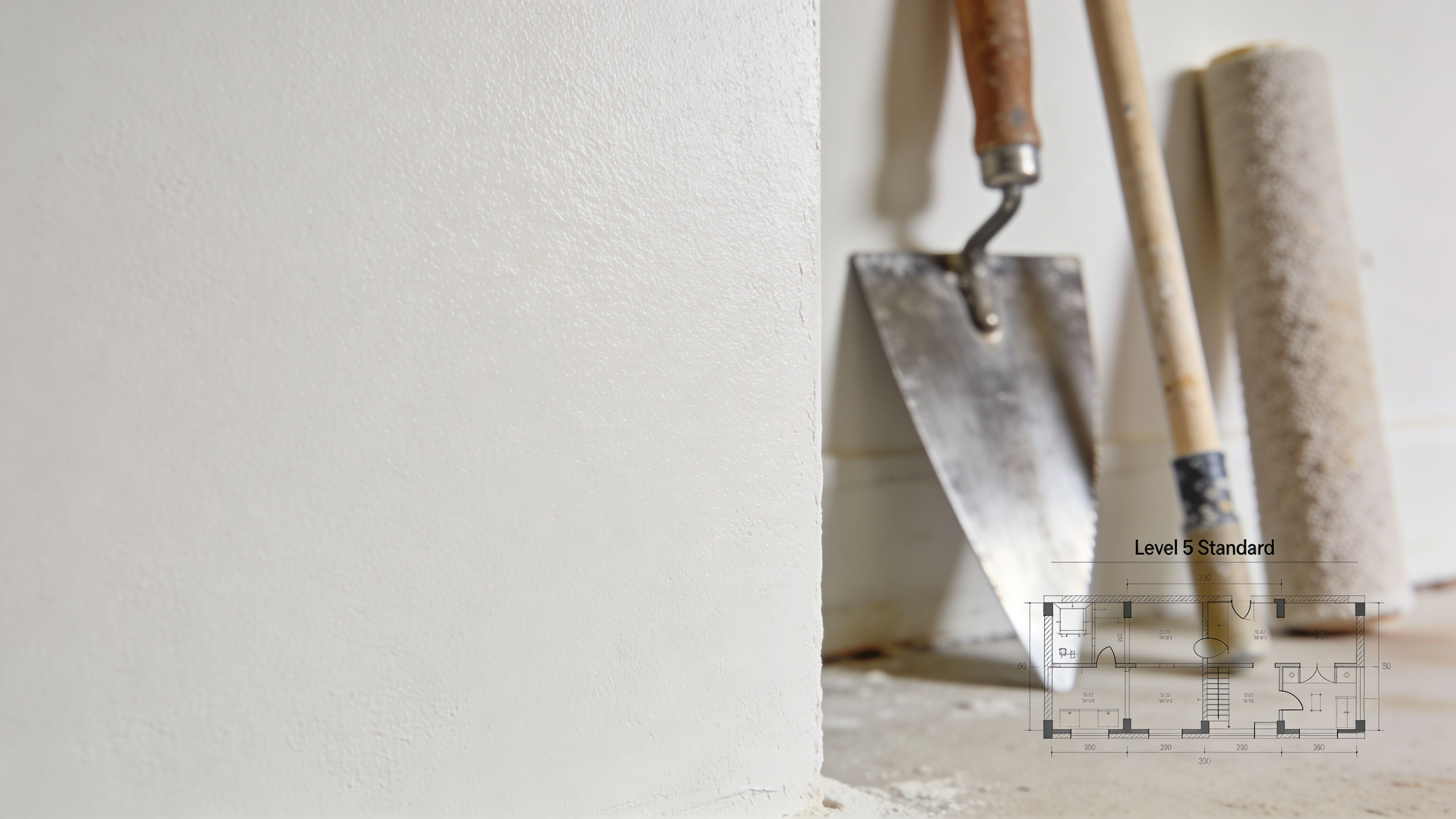
A Level 5 finish is the highest drywall finish standard. The Gypsum Association standard says it includes all Level 4 operations plus a thin skim coat over the entire surface, which is what helps resist visible flaws under critical lighting. That added step is also why it carries a 30-100% cost premium over Level 4, as explained in National Gypsum’s overview of Level 4 vs Level 5 drywall finish differences.
What makes it different
The practical difference is surface consistency.
A Level 4 finish handles taped joints, corners, and fasteners to a professional standard. A Level 5 finish goes further by skimming the whole surface so the wall reads more evenly after primer and paint. Think of Level 4 as a well-finished wall for normal use. Think of Level 5 as the finish used when lighting and paint will expose every transition.
That matters a lot in remodels where old patches, repaired cracks, or mixed surfaces are involved. If you’re fixing damaged areas before refinishing, the work often starts with proper drywall repair so the skim coat has a sound base.
Where Level 5 makes sense
Some rooms practically ask for it.
- Large windows and side light: Morning or afternoon light can drag across the wall and reveal joint lines.
- Smooth modern interiors: Minimal trim and simple paint colors leave nowhere to hide unevenness.
- Higher sheen paint: Gloss and semi-gloss reflect more light and show more defects.
- Commercial interiors: Clinics, retail spaces, restaurants, and reception areas often need a cleaner finish because people look at the walls up close.
- Pre-sale upgrades in premium neighborhoods: Buyers notice finish quality fast when the home is staged and brightly lit.
This walkthrough gives a useful visual of the finish standard in practice:
A Level 5 finish is usually less about drywall itself and more about protecting the final look after paint and lighting do their job.
What doesn’t work is specifying Level 5 in one showcase room, then cutting corners on prep or trying to blend that finish into damaged adjacent walls without proper correction. The finish is only as good as the substrate under it.
Level 4 vs Level 5 Finish A Practical Comparison
A homeowner in Portland usually notices the difference between Level 4 and Level 5 after paint, not during drywall. The walls look fine at first. Then late afternoon light hits the living room wall, or a satin paint goes up in the entry, and the joints start to print through. That is the point where the extra money either feels justified or wasted.
Side by side comparison
| Feature | Level 4 Finish (Industry Standard) | Level 5 Finish (Premium Standard) |
|---|---|---|
| Base process | Three coats over taped joints and fasteners, then sanded smooth | Includes Level 4 operations plus skim coat over entire surface |
| Typical use | Standard residential walls and ceilings | High-visibility walls and ceilings |
| Best paint fit | Flat paint is usually a safe choice | Better suited for gloss, semi-gloss, and demanding smooth paint finishes |
| Lighting performance | Can show joint shadows or small surface changes under severe lighting | Designed to reduce visible telegraphing under critical lighting |
| Cost relationship | Lower-cost professional standard | Premium option with added labor and finishing steps |
On paper, the difference looks small. On a finished wall, it can be obvious.
Level 4 is the right call for a lot of Portland-area homes. It performs well in bedrooms, secondary hallways, rental properties, and remodels where the paint is flat and the lighting is soft. If the room does not have long stretches of wall under side light, the upgrade to Level 5 may not give you much back.
Level 5 earns its keep in rooms buyers study. Main living spaces, tall entry walls, kitchen runs, primary bedroom ceilings, and any wall facing large windows are common examples. In places like Lake Oswego and parts of West Linn, that cleaner finish can support the overall impression of a higher-end home. In Beaverton, it often makes sense in newer homes with open layouts, big windows, and simple trim packages where wall quality is easier to judge.
When Level 4 is good enough
Level 4 is often enough when:
- The paint will be flat or low-sheen
- The room has even, forgiving light
- The wall is not a focal point
- The budget has better uses, such as repair work, paint quality, or trim upgrades
- The home is being improved for function and clean presentation, not a luxury resale impression
That trade-off matters. I have seen homeowners spend for Level 5 in every room, then cut back on paint or surface prep to stay on budget. That usually hurts the final result more than choosing Level 4 in the low-visibility rooms and putting the money where it will show.
A smart approach is to split the scope. Use Level 5 where lighting and resale expectations are high. Use Level 4 where it will perform just as well to the eye. That gives homeowners a better return than treating the whole house like a showroom.
There is also a property-value angle. In premium submarkets, finish quality supports asking price because buyers notice the whole package. Smooth walls, clean lines, and fewer visible joints help staged homes photograph better and show better in person. In a standard family home in Tigard or Gresham, that same upgrade may be harder to recover dollar for dollar. In Lake Oswego or a polished Beaverton remodel, it can be part of what helps the house feel worth the premium.
The short version is simple. Level 5 is not automatically the better investment. It is the better investment in the right rooms, in the right house, for the right buyer.
Breaking Down the Level 5 Finish Cost in Portland
The number homeowners focus on first is square foot pricing, and that’s useful. For 2026, the national range for a Level 5 finish is $2.50 to $3.50 per square foot, while high-demand markets like Portland can reach $2.75 to $4.50 per square foot. That same source notes that Level 5 takes approximately 40% more labor hours than Level 4, which is the main reason the premium exists, as outlined in this 2026 drywall finish cost breakdown.

Where the money goes
Labor is the biggest cost driver. That’s because the finish takes more touch time, more drying coordination, more sanding discipline, and tighter inspection standards than a standard wall finish.
A proper Level 5 scope usually includes:
- Surface prep: Existing cracks, dents, previous patches, corner damage, or water-related issues have to be corrected first.
- Protection work: Floors, trim, cabinets, fixtures, and adjacent spaces need masking and containment.
- Skim application: The entire face of the drywall gets treated, not just the seams.
- Sanding and correction: The finish gets refined, then checked again for visible defects.
- Primer readiness: The wall needs to be uniform and ready for the next trade.
What changes the final price
Not every Portland-area project lands in the same part of the range. The final quote usually shifts based on room conditions and access.
Here are the factors that move cost up or down:
- Existing wall condition: New drywall in a clean remodel is simpler than old walls with repair history.
- Ceiling height: Tall walls and stairwells slow production and increase setup time.
- Lighting exposure: Rooms with large windows or directional fixtures demand stricter correction.
- Occupied versus vacant home: Dust control and daily cleanup matter more when people are living in the space.
- Project size: Small, isolated rooms often cost more per square foot than larger continuous areas.
For homeowners in Hillsboro, Beaverton, Portland, and Vancouver, WA, this is why two rooms with the same dimensions can price differently. The drywall finish itself may be the same standard, but the prep and correction load may not be.
A careful bid should explain the scope clearly. If it doesn’t mention prep, surface correction, protection, and finish level in plain language, the number may not tell the full story.
Sample Level 5 Project Estimates for Local Homes
Square foot pricing helps, but individuals often budget by room. That’s a more practical way to think about level 5 drywall finish cost when you’re planning a remodel or preparing a home for sale.
Labor is the main driver. Specialist labor is typically $65 to $75 per hour, and an average-sized room can take 6 to 8 hours, which puts labor alone at $390 to $600 before materials, according to this Level 5 finish labor cost overview.

Bedroom remodel in Tigard
A common example is a primary bedroom update where one wall was opened for electrical work and a larger window brings in stronger side light than before.
If the walls are in generally good condition and the homeowner wants a smoother painted result, a Level 5 finish makes sense on the most visible surfaces. The budget usually rises if there are old repairs, texture transitions, or trim changes that need to disappear cleanly.
Open living area in Beaverton
Level 5 often offers clear benefits.
An open living and dining space with recessed lighting, broad wall planes, and modern paint colors gives defects nowhere to hide. In these rooms, the skim coat helps unify surfaces so they read consistently from one end of the space to the other. Homeowners in newer Beaverton remodels often notice that a standard finish can look fine near the kitchen and noticeably weaker near the windows.
In a large open room, inconsistency is usually more visible than any single defect.
Small commercial waiting room in Hillsboro
A clinic waiting room, reception area, or boutique retail front space is another strong candidate. People sit still in these rooms and look at the walls. Clean finishes matter more in that setting than in a back office or storage area.
Commercial clients also tend to care about presentation after paint, especially when lighting is bright and directional. In that situation, choosing Level 5 on public-facing walls and Level 4 in service areas is often the balanced approach.
These examples show why room function matters more than blanket rules. One home may only need Level 5 in a front entry and main living wall. Another may benefit from it in every visible common area.
If you want a local quote tied to your actual rooms, wall condition, and paint plans, it helps to start with a contractor who also handles drywall installation, painting coordination, and related interior work. For nearby service areas, see the Portland drywall contractor page.
Hiring a Contractor for a Level 5 Finish
Level 5 is not the place to buy on price alone. A low number can mean the contractor is calling it Level 5 without planning the prep, skim consistency, correction passes, or site protection that the finish demands.
Questions worth asking
Ask direct questions and listen for direct answers.
- Is GA Level 5 written into the proposal? If it’s not stated clearly, assumptions will take over.
- How will you handle dust control and masking? Skim coating and sanding affect the whole space.
- What prep is included before the skim coat? Cracks, patches, damaged corners, and uneven previous work should be addressed first.
- Will you review lighting conditions before final sanding? Rooms with strong windows or LED fixtures need a closer eye.
- Can you show examples of smooth wall projects? You want proof of finish quality, not just installed drywall.
What a strong proposal should include
A solid bid usually describes the finish level, prep scope, affected areas, and what happens before primer or paint. It should also make clear whether the quote covers only newly installed board or also includes existing wall correction.
For homeowners in premium markets, the quality of this work can matter beyond appearance. As noted earlier, smooth high-end finishes can support stronger presentation at resale in areas like Lake Oswego, where buyers tend to notice wall quality under modern lighting.
Good finish work is easy to underestimate before paint and impossible to ignore after paint.
If a contractor avoids specifics, treats Level 5 like a vague upgrade label, or can’t explain where Level 4 is perfectly acceptable, that’s usually a warning sign. The right contractor should help you spend wisely, not just spend more.
Get a Flawless Finish for Your Portland Project
You see the difference the day the paint goes on. In a Portland home with big west-facing windows or crisp LED lighting, a weak finish shows every joint, patch, and sanding mark. A true Level 5 finish costs more up front, but in the right rooms it protects the look of the whole project.
That added cost pays off best where buyers notice details. In places like Lake Oswego and parts of Beaverton, smooth walls can support a stronger first impression during resale, especially in remodeled kitchens, primary suites, and open living areas with flat paint and modern trim. In a rental, a basement, or a secondary bedroom with softer light, Level 4 is often good enough and a better use of the budget.
The smart move is to evaluate the house room by room. Put Level 5 where light exposes flaws and where finish quality adds market appeal. Keep Level 4 in lower-visibility areas when the wall plane is sound and the design does not call for a glass-smooth surface.
If you’re planning drywall work in Portland, Beaverton, Hillsboro, Tigard, Lake Oswego, Gresham, Tualatin, Forest Grove, Cornelius, or Vancouver, WA, ask for an estimate that separates new drywall finishing from correction work on existing walls. That helps you see what you are paying for and where the upgrade makes sense.
Need help with smooth walls, drywall repair, interior painting, or a full remodel finish package? Contact CS1 Real Interiors.


