

A lot of Portland homeowners stand in their basement and see possibilities before they see risk. Maybe it could become a family room, a home office, a gym, or a guest space. Then you look closer. The concrete feels cool, the air feels heavier than the rest of the house, and you start wondering whether the same drywall used upstairs belongs down here.
That question matters more in the Pacific Northwest. In Portland, Beaverton, Hillsboro, Tigard, and Vancouver, WA, below-grade spaces deal with damp air, seasonal moisture swings, and the occasional surprise from a wall, slab, or pipe. A basement can look dry and still be a bad place for the wrong wallboard.
The best drywall for basement projects isn't just about what hangs easiest or costs less at the store. It's about picking a wall system that matches the moisture risk of the space, then installing and finishing it in a way that doesn't create mold problems later. If you get that call right, a basement can hold up well. If you get it wrong, you can end up tearing out finished walls that looked fine when they went up.
Table of Contents
- Choosing Drywall for Your Portland Basement
- Why Basements Need Specialized Drywall
- A Detailed Comparison of Basement Wallboard Types
- Is Your Project Ready? Get a Professional Assessment
- Installation and Cost Factors for Basement Drywall
- Finishing and Painting for a Durable Basement
- Your Decision Guide and When to Call a Pro
Choosing Drywall for Your Portland Basement
A basement remodel usually starts with optimism. Homeowners in Portland metro clear out storage, sketch a layout, and assume the wall finish decision will be simple. Then the basement reminds them it's not a normal room.
Below grade, the rules change. The wall assembly has to deal with cool concrete, trapped humidity, and moisture that can move through foundation walls or show up from condensation. That's why the best drywall for basement work isn't the cheapest white board on the rack.
In older homes around Portland and nearby cities, I've seen the same pattern. The basement gets framed and drywalled before anyone asks where the moisture is coming from. Everything looks clean for a while. Then the base of the wall starts telling the truth. Tape loosens, corners soften, paint changes, and that musty smell shows up.
Practical rule: If your basement has a moisture story, your drywall choice needs to answer that story.
The good news is that there is a practical way to choose. Start with the condition of the basement itself. Is it consistently dry, or does it get seasonal dampness? Has it ever had water intrusion? Are you finishing a living area, a laundry zone, or a wall near a bathroom or utility line?
Those questions matter more than marketing labels.
For homeowners planning a remodel in Portland or a nearby city, the right material decision usually leads to fewer repairs and fewer regrets. If you're still sorting out prep work before hanging board, it also helps to look at local project examples and service coverage, especially if you're comparing options in Portland drywall projects.
Why Basements Need Specialized Drywall
A Portland basement can look dry in July and still cause trouble by November. I see that a lot. The walls feel cool, the room holds damp air longer than the rest of the house, and any weak point in the wall assembly shows up first at the drywall.
That is why basement drywall is a risk decision, not just a product decision.
Above-grade rooms usually forgive small mistakes. Basements usually do not. Concrete can pass moisture inward. Cold foundation walls can create condensation when warmer indoor air hits them. Minor leaks around plumbing or at the foundation can stay hidden behind finished walls until the board softens, tape releases, or mold starts feeding on the paper facing.
Standard white drywall fails faster in that setting. Moisture-resistant drywall can buy some margin, but it is still not a cure for a wet basement. If the wall assembly is wrong, the board becomes the part that shows the damage first.
Start with the moisture pattern, not the drywall label
Homeowners often ask which drywall is best for a basement. The better question is what kind of moisture the basement deals with. A basement that stays dry year-round is a different project from one with seasonal dampness, cold wall condensation, or a history of water intrusion.
That distinction drives the material choice.
If the space has only light humidity and the foundation stays dry, a moisture-resistant panel may be enough. If the basement has recurring damp conditions, a stronger mold-resistant or paperless option usually makes more sense. If walls are near direct water exposure, drywall may not be the right finish at all for that area.
Before hanging any board, check the conditions that shorten its life:
- Foundation moisture: staining, efflorescence, peeling paint, or damp patches on concrete
- Condensation risk: cold walls, limited insulation, and humid indoor air
- Hidden water exposure: supply lines, drains, shutoffs, and utility areas
- Air control: poor ventilation after laundry, showers, or wet weather
- Insulation approach: a cold wall behind finished drywall often becomes the spot where moisture collects. Homeowners sorting through that assembly often review Airtight Spray Foam basement solutions before choosing wallboard
I tell clients the same thing on basement remodels. Drywall should finish a wall system that already manages moisture. It should not be asked to absorb the risk.
That approach saves money for the long haul. It also helps avoid the common Portland mistake of choosing a board based on the store label instead of the basement's actual moisture behavior.
A Detailed Comparison of Basement Wallboard Types
A basement wallboard choice is really a risk choice. In Portland, I see homeowners pick a panel by label color or price, then find out two winters later that the wall cavity was the actual problem and the board was only the first thing to show it.
The right panel depends on how your basement behaves through the wet season, not how it looks on a dry afternoon in August.
Basement Drywall Options at a Glance
| Drywall Type | Best For | Moisture/Mold Resistance | Relative Cost |
|---|---|---|---|
| Moisture-resistant drywall | Basements that are generally dry but still below grade | Moderate | Lower |
| Moisture-and-mold-resistant drywall | Most finished basements with meaningful humidity or past dampness | Stronger | Moderate |
| Paperless drywall panels | Basements where long-term moisture resilience matters most | Very strong | Higher |
| Cement board | Wettest areas or walls near direct water exposure | Very strong | Higher |
A quick table helps, but performance is decided after the board is on the wall and the basement goes through a full year of rain, cold concrete, indoor humidity, and normal use.
A major home improvement retailer's drywall guide also points out a practical sizing issue homeowners often miss. Standard drywall is usually 1/2 inch, while 5/8 inch is the heavier option commonly used where sag resistance and stiffness matter more, especially on ceilings. You can review that in the Lowe's drywall buying guide.
Moisture-resistant drywall
This is the product many homeowners know as green board. It gives you a modest step up from standard drywall, but it still has a paper face, and that matters in a basement.
I use it only in lower-risk basement conditions. That means the foundation has stayed dry, the wall assembly is insulated correctly, and the room is not carrying ongoing humidity from laundry, a bathroom, or poor air movement. In that setting, moisture-resistant drywall can be a reasonable budget choice.
It is still a limited product.
Use it when:
- The basement has a clean moisture history: No recurring damp smell, staining, or seasonal softness in finishes.
- The room is low risk: Storage, light-use space, or a basement area that stays dry year-round.
- You want a small upgrade over standard drywall: It improves the margin a bit without the cost of better specialty panels.
Skip it when:
- The basement has had water or chronic humidity: Past moisture problems usually return in some form.
- The room will be finished as living space: Offices, TV rooms, guest rooms, and playrooms deserve a wallboard with better tolerance for real basement conditions.
Moisture-and-mold-resistant drywall
For basement drywall, this is usually the safest starting point for a finished space. It suits many Pacific Northwest basements, where you may not have standing water, but you do have cool walls, seasonal humidity, and occasional moisture stress.
This category gives you a better buffer against the kind of conditions that slowly break down ordinary wallboard. It is still not waterproof. If bulk water gets in, this board can still fail. But in a basement that is mostly dry with some real-world humidity swings, it is often the best balance of cost, finish quality, and service life.
I recommend this type often because it matches how Portland-area basements age.
A few practical points:
- Walls can benefit from 5/8-inch board: It feels more solid and takes abuse better in finished basement rooms.
- Ceilings often deserve 5/8-inch board: The added stiffness helps reduce sagging over time.
- The wall assembly still matters more than the label: Good drywall cannot make up for damp concrete, missing air control, or poor insulation details.
Paperless drywall panels
Paperless drywall solves one of the weak links in a basement wall. It removes the paper facer that mold can use as a food source if moisture gets into the assembly.
That does not make it waterproof, and I would not sell it that way. What it does give you is better resilience in basements where moisture risk is not severe enough to rule out drywall, but is high enough that a paper-faced product feels like a gamble.
For homeowners planning to stay in the house for years, this is often the better long-term drywall option. The trade-off is cost, and sometimes finish labor. Some crews are less comfortable with fiberglass-faced products, so the finish quality depends more on installer experience than it does with standard paper-faced board.
Paperless drywall makes the most sense when:
- The basement has a history of damp seasons: Not flooding, but enough moisture to make paper-faced products a concern.
- You want a finished drywall look with better mold resistance: It preserves the appearance people want in a living space.
- You are building for durability, not just initial price: Paying more up front can avoid opening walls later.
If drywall still feels like the wrong finish for your basement, compare durable basement wall alternatives before committing to a framed wall system.
Cement board
Cement board has a place in basements, but that place is limited. I use it in areas with direct water exposure or a very high chance of repeated wetting, not across an entire family room or office.
Its strength is moisture tolerance. Its downside is that it is heavier, less pleasant to cut and install, and more work to finish if the goal is a smooth painted wall. For general living areas, that usually makes it the wrong material.
Use cement board in basement conditions like these:
- Shower walls or bathroom-adjacent wet zones
- Utility areas with unusual moisture exposure
- Specific wall sections where water contact is a realistic risk
For the rest of the basement, choosing the toughest board available can create more labor and cost without solving the actual problem. The smart choice is the board that matches the risk level of that wall. That is how you avoid paying twice for the same basement.
Is Your Project Ready? Get a Professional Assessment
A basement can look dry in August and still be the wrong place for standard drywall once Portland rain sets in. I see that problem after the walls are closed up, when a homeowner starts noticing a musty smell, soft corners, or staining near the slab line. By then, the board choice is no longer the only issue. The wall assembly was built without matching the material to the moisture risk.
Before any drywall order goes in, the basement needs a hard look at the conditions behind the finished surface.
What should be checked first
A proper assessment should answer a few practical questions:
- Is the concrete dry enough for a finished wall? Look for darkening, staining, efflorescence, or areas that stay cool and damp longer than the rest of the room.
- Will the framing keep drywall out of trouble? Check spacing, straightness, bottom plate protection, and whether ceiling spans call for heavier board.
- Are there moisture points that will be buried later? Water lines, shutoffs, cleanouts, sump areas, and exterior foundation transitions should be planned before they disappear behind board.
- Does the room use match the wall system? A storage wall, home office, TV room, and bathroom-adjacent area do not carry the same risk.
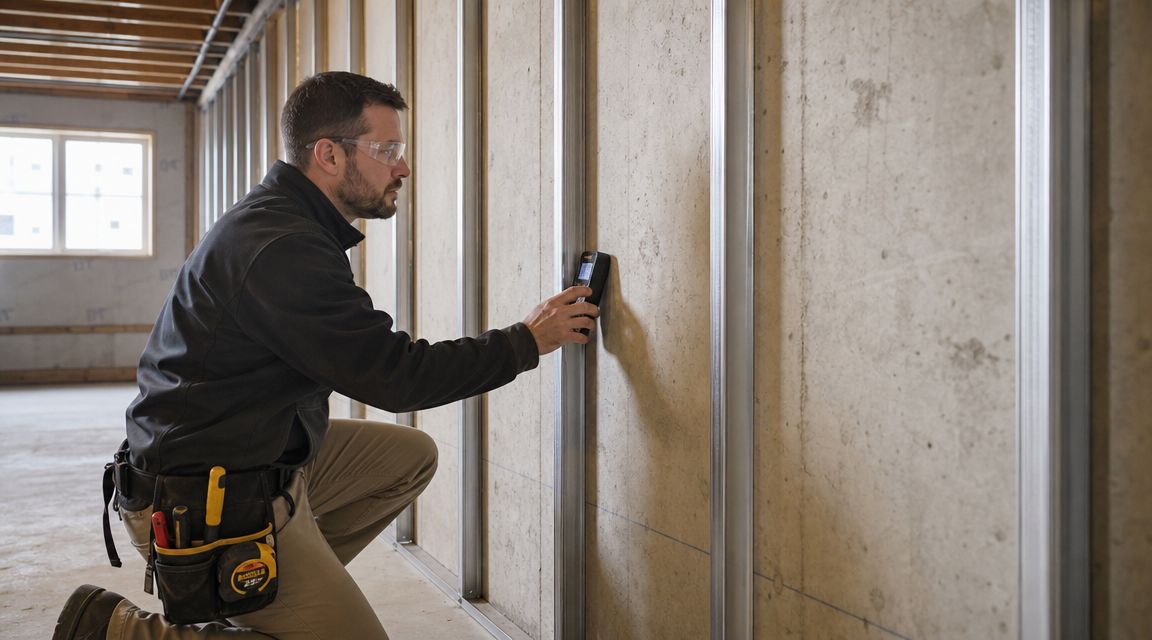
This step matters more in Pacific Northwest basements because the problem is often repeated dampness, not dramatic flooding. That kind of moisture is easy to underestimate. It can sit against concrete, move into framing, and reach the back of the drywall long before you see damage on the painted face.
CS1 Real Interiors handles drywall installation, repair, painting, insulation, and metal stud framing for residential and small commercial interiors across the Portland metro area. For a basement project, that matters because the wall should be evaluated as a system. Drywall, framing, insulation, and access details all affect whether the finish will hold up.
If you are unsure whether your basement is ready, schedule a walk-through before buying materials. A professional assessment can tell you whether the room is ready for drywall, needs drying or waterproofing work first, or calls for a different wall plan to avoid expensive tear-out later.
Installation and Cost Factors for Basement Drywall
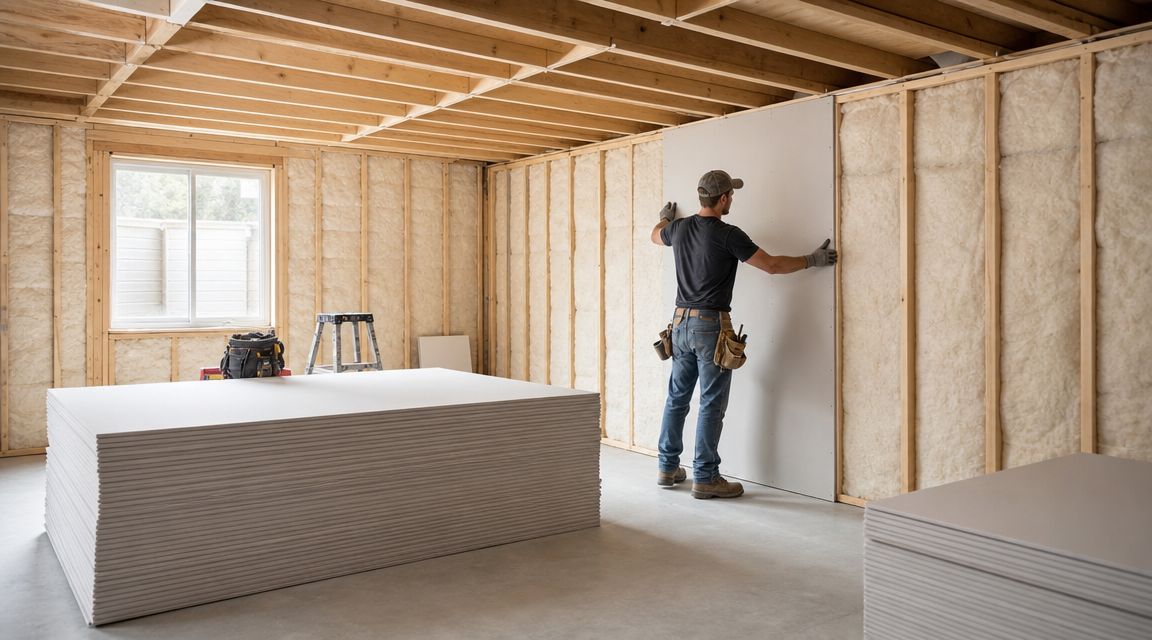
The board itself is only one line item. Basement drywall cost and performance are shaped by prep work, framing, insulation choices, tape, finishing method, and how much correction the room needs before install day.
Material cost is only part of the job
Homeowners often compare drywall by sheet price. That's understandable, but it misses the bigger picture. A basement that needs moisture corrections, upgraded insulation, or heavier ceiling board can change the labor and material scope fast.
These are the cost drivers that matter most:
- Board type: Standard, moisture-resistant, mold-resistant, paperless, and cement-based products don't install and finish exactly the same way.
- Board thickness: Heavier panels add handling effort, especially overhead.
- Surface condition: Uneven framing, out-of-plumb walls, and low ceilings all slow production.
- Access and protection: Tight stair access, occupied homes, and furnished basements add labor.
For repair work after leaks or damage, the quote should also address demolition, drying time, and finish matching. If your basement already has damage, it helps to review drywall repair services before assuming a patch is the only work needed.
The assembly matters as much as the board
CertainTeed says moisture-and-mold-resistant drywall is best for basements and should be paired with fiberglass mesh finishing tape rather than standard paper tape because paper tape can undermine moisture resistance. That guidance is outlined in CertainTeed's drywall selection guide.
That's an important point. Basement durability comes from the system, not just the panel.
A basement wall can fail at the seams long before the field of the board looks bad.
That changes how a professional estimate should be read. You want to know what tape will be used, how joints will be treated, what board thickness is planned for ceilings, whether the framing spacing supports that choice, and whether the room needs additional prep to stay dry over time.
A short video can help you visualize the installation side of the work:
The labor side matters just as much in a basement as the material side. Hanging heavier board on a ceiling, keeping joints clean in a confined space, and producing a paint-ready finish are all places where rushed work shows up later. That's especially true in older Portland homes where no two basement walls seem to behave the same.
Finishing and Painting for a Durable Basement
A basement drywall job isn't finished when the sheets are hung and taped. The final protection comes from the way the walls are finished, primed, and painted.
Finish for durability, not just appearance
A basement needs more than a decent color choice. It needs a finish approach that respects moisture movement and daily use. Mud work has to be clean, corners have to be stable, and the final surface has to accept primer and paint evenly.
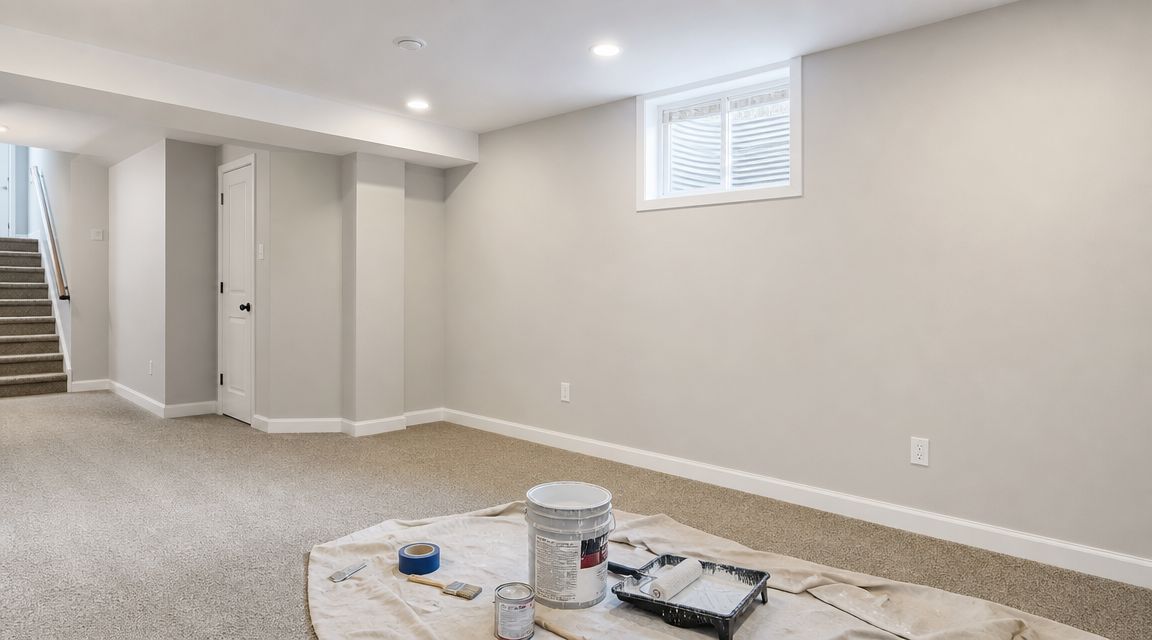
For finished basement rooms, smooth walls usually look best when the prep is thorough. In practical terms, that means sanding dust is controlled, repairs are feathered well, and primer is not treated like an optional shortcut. The wrong finish sequence can leave flashing, visible joints, or soft spots around repairs.
A few finishing habits make a real difference:
- Prime new drywall properly: Fresh board and joint compound absorb differently.
- Use coatings suited to humid spaces: Basement walls need products that hold up better when air conditions change.
- Don't rush paint over damp surfaces: Even good products can struggle if the substrate isn't ready.
Insulation and paint need to work together
A durable basement wall isn't just drywall plus paint. Insulation, air sealing, and temperature control all affect how the finish performs. If the wall stays cold behind the drywall, interior coatings can end up dealing with condensation that really started as an insulation problem.
For homeowners comparing rigid insulation layers, reviewing understanding foam board R-values can help clarify how insulation thickness affects the overall wall plan. That's useful before drywall goes up, not after paint starts failing.
If your project includes both wall finishing and repainting, hiring one crew to manage the sequence usually reduces problems. Drywall finishing and interior paint work need to be coordinated, especially in basements where timing, drying, and surface prep matter more. That's why many homeowners bundle this scope with interior painting services.
The cleanest-looking basement is usually the one where the prep work was handled with patience, not speed.
Your Decision Guide and When to Call a Pro
A Portland basement can look dry for months, then show its real behavior after a long stretch of winter rain. That is why drywall choice should start with moisture risk, not with whatever board was cheapest or easiest to get.
The goal is simple. Match the wallboard to the conditions the basement has, not the conditions you hope it has.
A practical way to choose
Start by being honest about the space.
- Use standard drywall only in a basement with a proven dry history. That means no musty smell, no staining, no seasonal dampness, and no signs that exterior walls or slab edges pick up moisture during wet months. In Portland-area homes, that is less common than people think.
- Use moisture- and mold-resistant drywall when the basement stays a little humid or has had minor dampness before. This is often the safer middle-ground choice for finished basements that are below grade but not dealing with active water entry.
- Use paperless board when mold risk is the bigger concern. If the basement has had repeated humidity issues, intermittent condensation, or past microbial growth, fiberglass-faced panels hold up better because they do not have a paper facer that can support mold growth.
- Use tile backer or another wet-area panel where surfaces may get directly wet. Basement bathroom walls, shower surrounds, and utility areas should not be treated like the rest of the basement.
- Use the right thickness for the job. Basement ceilings and wider framing spans usually benefit from 5/8-inch board because it resists sag and takes abuse better. Many wall applications still use 1/2-inch successfully, but ceilings are where I see shortcuts cause problems later.
If the basement has any history of water on the floor, staining at the bottom of the walls, or efflorescence on masonry, pause before hanging any drywall. New board can hide the warning signs for a while. It does not solve them.
When it makes sense to call a pro
DIY can work in a dry, straightforward basement. It stops making sense once the moisture story is unclear.
Bring in a professional if any of these apply:
- You do not know whether the problem is humidity, condensation, or bulk water. Those are different failures, and the drywall plan changes with each one.
- There is past water damage and you are not sure how far to open the wall. Partial replacement often misses hidden damage in insulation, framing, or the back side of the board.
- You are hanging board on a ceiling. Overhead work is physically demanding, and thicker panels leave less room for installation mistakes.
- You want the basement to feel like finished living space. Low light and long wall runs make seams, waves, and patching stand out.
- The project also involves insulation, framing, or paint. In basements, those pieces affect drywall performance just as much as the panel itself.
I tell homeowners this all the time. A drywall problem in a basement is often a moisture management problem wearing a drywall costume.
For homes in Portland, Beaverton, Hillsboro, Tigard, Lake Oswego, Gresham, and Vancouver, WA, the smart move is usually to assess the basement as a system. Wallboard, insulation, air movement, and surface temperature all work together. If one part is wrong, the finish may look fine at first and fail early.
If you're planning a basement remodel or dealing with moisture-damaged walls, CS1 Real Interiors can help you sort out the right drywall, prep, and finishing approach for your space. Professional input is especially useful when the basement has mixed signals, such as occasional dampness, cold exterior walls, or old repairs that never fully solved the problem.