



You notice it while the light hits the wall at an angle. A small round bump. Maybe a hairline ring in the paint around it. At first it looks harmless, the kind of thing you plan to deal with later. Then you see another one on the ceiling, and suddenly that “tiny blemish” starts to feel like a pattern.
That's the usual start of a nail pops repair job in Portland area homes. In older houses, it often shows up after years of movement. In newer homes around Beaverton, Hillsboro, or Tigard, it can show up during normal settling and drying. The good news is that many nail pops are repairable. The bad news is that a quick smear of spackle over the bump usually won't hold, and on smooth walls the patch can stay visible long after the pop is gone.
If your goal is a repair that disappears into the wall, not just one that hides the bump for a few weeks, technique matters.
Table of Contents
- That Annoying Bump on Your Wall What Is a Nail Pop
- Why Nail Pops Happen in Portland Area Homes
- Your Toolkit for a Flawless Nail Pop Repair
- How to Properly Fix Drywall Nail Pops
- Achieving an Invisible Patch and Matching Texture
- When to Call a Professional Drywall Contractor
That Annoying Bump on Your Wall What Is a Nail Pop
Most homeowners first assume it's a paint problem. It isn't. A nail pop is a fastener problem. The bump forms when the nail or screw loosens and the drywall is no longer fully secured to the framing. That's why patching only the surface often fails.
One practical detail surprises people. The finished defect is often about the size of a quarter, which makes it easy to dismiss at first. That small size is exactly why nail pops get ignored until a room has several of them or until repainting makes them stand out even more. That repair guidance comes from this nail pop repair reference.
What it usually looks like
A typical pop starts with a faint circle or tiny crack in the paint. After that, the center rises enough that you can feel it with your hand. On ceilings, the light catches it even faster. On smooth walls, especially in updated Portland interiors, even a small pop can become obvious.
There's a big difference between a single loose fastener and a larger wall problem. One isolated bump usually points to local movement at one fastening point. A line of pops, repeating cracks, or signs of moisture call for a closer look before anyone starts patching.
Practical rule: If you can press on the area and feel movement, treat it like a fastening issue first and a finishing issue second.
Why homeowners misread the problem
The wall still feels mostly solid, so the defect seems cosmetic. But the surface is telling you that the drywall lost some hold at that spot. That's why the repair has to do more than hide the blemish. It has to lock the panel back to framing and then blend the finish so the patch doesn't flash through paint later.
In Portland bungalows, suburban remodels, and newer tract homes alike, this is one of the most common “small” drywall issues that turns into a repeat callback when it's handled the wrong way.
Why Nail Pops Happen in Portland Area Homes
Nail pops don't happen for one single reason. They show up when framing moves, dries, settles, or when the original fastening wasn't done cleanly. Around Portland, that matters because homes across the metro vary a lot. An older house in Portland proper behaves differently than a newer build in Hillsboro, but both can produce the same symptom on the wall.
New homes deserve special mention. Guidance for new housing notes that homes may continue to settle and dry for 6–12 months, which is why some pops show up after move-in rather than during construction. That same guidance says repeated pops in the same area can deserve follow-up. You can read that in this guidance on shrinkage cracks and nail pops.
The common causes I see most often
- Normal settling in newer construction means framing members are still adjusting after the house is closed in.
- Seasonal movement can nudge fasteners loose over time, especially where ceilings and upper walls show slight movement.
- Poor fastening at install creates a weak point from day one. If the board wasn't held tight to framing, the finish layer eventually tells on it.
- Local wall stress near doors, windows, and transition points can make one area show problems before the rest of the room.
For homeowners dealing with recurring surface issues, a broader drywall repair service in Portland metro homes often makes more sense than repeated spot patches.
Why some repairs keep failing
A lot of failed DIY repairs have the same story. Someone pushes the old fastener back in, adds compound, sands, paints, and the bump returns. The underlying movement never got addressed. The wall looked fixed for a short time, but the board still wasn't secured well enough.
If the same spot reappears, the problem usually isn't the mud. It's the fastening.
In Portland, Beaverton, and Vancouver WA, I also see a finish issue layered on top of the mechanical issue. Smooth walls make minor defects look bigger. So even when the wall is stable again, poor patch blending can leave a repair visible every time afternoon light hits the room.
Your Toolkit for a Flawless Nail Pop Repair
A clean nail pops repair doesn't require a truck full of tools. It does require the right few. The goal is simple. Re-secure the drywall, patch in thin coats, and leave a surface that sands clean and paints evenly.

What you actually need
- Drywall screws: Use screws rather than relying on the popped fastener. If you're stocking up for multiple repairs, a bulk box like these 4000-piece drywall fasteners can be useful for homeowners, maintenance teams, or property managers handling repeat patch work.
- Driver or drill: You need control more than speed. The screw should sit slightly below the surface without tearing the paper.
- Putty knife or taping knife: A narrow knife helps with the first coat. A wider one helps feather the patch.
- Joint compound: Quick-setting compound helps if you want faster turnaround. All-purpose mud works, but it usually takes longer and often needs more drying time.
- Sanding sponge or fine sanding block: This helps smooth the patch without gouging the surrounding paint.
- Primer and matching paint: Skipping primer is one of the main reasons a repair shows through.
Quick-setting mud versus all-purpose mud
This choice changes the pace of the repair. Quick-setting compound is helpful when you want to move through coats faster in one day. All-purpose mud is easier for many homeowners to work with, but it can stay soft longer and slow the job down.
If you're repairing a visible wall in Lake Oswego or a smooth hallway in Tigard, the finish matters more than speed. In those spaces, it's usually smarter to choose the compound you can control best, not the one that sounds fastest.
How to Properly Fix Drywall Nail Pops
The repair starts by dealing with the fastener, not the finish. If you patch over a loose spot, you're only hiding movement. A durable repair means the drywall has to be held tight to framing again.
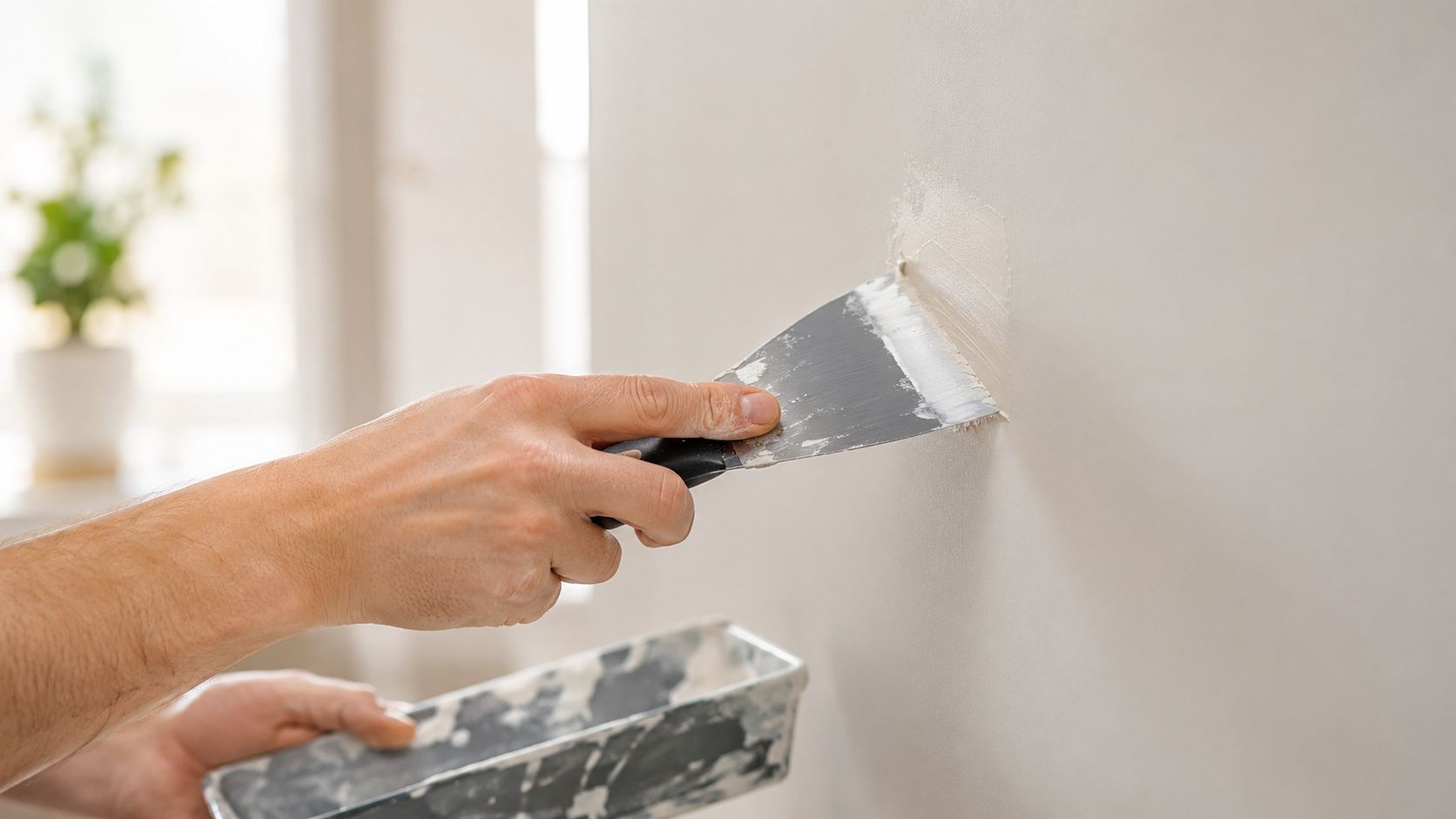
The standard method is a two-fastener stabilization job. Drive new drywall screws into the framing member about 1–2 inches above and below the original fastener. Reusing the original fastener alone doesn't reliably stop seasonal movement, according to this repair guidance on fixing nail pops.
Start with the wall, not the mud
Cut away any loose paint or crumbly compound around the pop. If the old fastener is proud and loose, remove it or reset it as needed. The point is to get rid of the failed hold, not trap it under fresh mud.
Then place the new screws into solid framing. This part matters. If the screw misses the stud or gets overdriven, you've created a new weak spot. The screw head should dimple the surface slightly without breaking the drywall paper face.
If you're also sorting out other wall-mount repairs nearby, this overview on choosing plasterboard anchors is useful context for understanding why fastening method matters so much in gypsum board.
Build the patch in thin coats
After the panel is secured, apply a thin first coat of compound over the repair area and over the screw heads. Don't try to finish it in one pass. Thick mud shrinks, cracks, and leaves more sanding than necessary.
Let the first coat dry fully. Sand it lightly, then apply a second coat wider than the first. Keep the edges thin. The flatter the transition, the easier the final paint blend will be.
This video shows the general repair process in action:
The fastener fix keeps it from coming back. The finish work keeps you from seeing where it was.
If the job starts turning into more than a single patch, or if you need the wall ready for paint with a cleaner finish, you can also request help through the free estimate contact form. CS1 Real Interiors handles drywall repair, interior painting, insulation, and metal stud framing for residential and small commercial interiors across the Portland metro area.
Achieving an Invisible Patch and Matching Texture
Most homeowners can fill a spot. Fewer can make it disappear. That difference is what separates a serviceable patch from a repair that blends into the wall under daylight, lamp light, and fresh paint.

Feather wider than the defect
The defect may be small, but the finish area usually needs to be wider. Experts recommend a multi-coat patch. Apply a thin first coat of joint compound, let it dry, sand lightly, then add a second coat. Quick-setting compound can reduce turnaround, while all-purpose mud often needs more coats and longer dry time, as shown in this professional repair demo.
That wider feather is what makes the patch disappear. If you leave a tight hump around the repair, paint will catch it immediately. On smooth Level 4 and Level 5 walls, this matters even more.
Smooth walls and textured walls need different thinking
On a smooth wall, your job is to erase edge lines. Sand lightly and keep checking the patch from the side, not just straight on. Side light reveals ridges fast.
On a textured wall, the patch can be flat and still look wrong. The texture pattern has to match the surrounding field closely enough that your eye doesn't stop on the repair. If you're practicing general patch blending on other damage types too, this homeowner's guide to fixing wall holes gives useful patching context.
Prime before paint. If you skip that step, the repaired area can flash through as a different sheen even when the patch feels smooth.
Why repainting makes or breaks the final look
A good patch can still look bad under paint if the sheen doesn't blend. On many Portland remodels, especially where homeowners want a cleaner modern look, smooth-finish walls leave little room for mistakes. That's why pros often widen the repair area, feather farther than a homeowner expects, and repaint enough wall area to make the blend disappear.
When to Call a Professional Drywall Contractor
One isolated pop usually falls into DIY territory. A room full of them doesn't. At that point, you're not just patching blemishes. You're diagnosing movement, fastening quality, moisture history, and finish expectations.
Guidance for new homes says that repeated nail pops in the same area or 8 or more nail pops in one room may justify professional follow-up because it can point to ongoing settling or installation issues. That threshold comes from this housing guidance on shrinkage cracks and nail pops.
Signs the repair is bigger than a small patch
- The same spot keeps coming back: That usually means the drywall still isn't secured well enough or the area is moving more than expected.
- You're seeing clusters, not singles: Multiple pops in one room change the job from cosmetic touch-up to pattern diagnosis.
- There are cracks or moisture signs too: Stains, soft drywall, or active cracking need a more careful repair sequence.
- The wall finish is high-visibility: Smooth entry walls, stairwells, and ceilings show patch defects fast.
For homeowners who want local help, it makes sense to work with a contractor familiar with homes across the metro, including drywall services in Beaverton.
A professional is also the right call when the appearance standard is high. In a rental turnover, a simple patch may be enough. In a remodeled living room in Portland or Lake Oswego with smooth walls and fresh paint, “good enough” usually still shows.
If the repair needs to hold up and disappear visually, request a free estimate through the CS1 Real Interiors contact form.
If you're dealing with recurring wall bumps, visible ceiling pops, or a patch that never seems to blend right, CS1 Real Interiors can help you sort out the cause and repair the finish properly. Request a free estimate to get professional help with drywall repair, interior painting, insulation, or metal stud framing anywhere in Portland, Beaverton, Hillsboro, Tigard, Lake Oswego, Gresham, or Vancouver WA.


