


A drywall problem usually starts small. A ceiling stain after a leak. A doorknob hole in the hallway. A crack above a doorway that keeps coming back after you paint it. Then it starts bothering you every time you walk past it.
In Lake Oswego, that frustration is often tied to appearance as much as damage. Homes here tend to have clean interiors, stronger resale expectations, and less tolerance for a patch that still shows in afternoon light. If you're deciding whether to patch it yourself, repair a larger section, or hire a pro for a paint-ready finish, the right answer depends on the type of damage and the finish you expect at the end.
This is a practical guide for homeowners who want a repair done right the first time. It covers what to look for, when a “simple” patch isn't really simple, and how to think about quality, timeline, and cost for drywall repair in Lake Oswego. If you're also getting a home ready for the market, these professional home staging tips can help you think beyond the patch and look at the room the way buyers will.
Demand for this kind of work isn't going away. The drywall repair services market is valued at USD 4.28 billion in 2025 and projected to reach USD 5.2 billion by 2035, reflecting steady need tied to leaks, remodeling, and property turnover in active housing markets like ours, according to this drywall repair services market outlook. For homeowners around Portland, Lake Oswego, and nearby communities, it's a common problem with a fixable path. If you need local service coverage, our Portland service area is a good place to start.
Table of Contents
- Your Guide to Flawless Drywall Repair in Lake Oswego
- Identifying Common Types of Drywall Damage
- DIY Repair vs Hiring a Professional Contractor
- Get Your Free Drywall Repair Estimate
- The CS1 Professional Repair Process Explained
- Costs and Timelines for Drywall Repair in Lake Oswego
- Your Drywall Repair Questions Answered
Your Guide to Flawless Drywall Repair in Lake Oswego
A clean drywall repair should disappear when the room is painted and the light hits the wall from the side. That's the standard most Lake Oswego homeowners want, especially in entryways, kitchens, living rooms, and primary suites where imperfections stand out quickly.
Drywall repair sounds simple until you get into the steps. Even a modest patch can involve cutting out damaged board, backing the opening, fitting a new piece, taping joints, applying multiple coats of compound, sanding, blending the surrounding surface, and preparing it for primer and paint. If the wall has texture, that adds another layer of skill.
What homeowners usually want
Clients aren't looking for a patch. They're looking for one of these outcomes:
- A repair no one notices: Best for visible walls, main living areas, and homes heading to market.
- A durable fix after damage: Important when a crack keeps returning or a wall was opened for plumbing or electrical work.
- A smooth surface for repainting or remodeling: Common before interior painting, trim upgrades, or kitchen and bath improvements.
- Fast make-ready work: Useful for rentals, turnovers, and smaller commercial interiors.
A drywall repair is finished only when it looks intentional with the rest of the room, not just when the hole is closed.
In practice, flawless work comes down to scope decisions. Some areas need a clean patch and texture match. Others call for replacing a larger section so the finish can be feathered properly. In higher-expectation homes, that decision matters as much as the patch itself.
Where quality matters most
The toughest spots are usually obvious ones:
- Ceilings under natural light
- Long hallway walls
- Areas next to windows
- Smooth walls with little texture to hide defects
- Rooms being repainted from corner to corner
That's where experience pays off. A rushed repair may look acceptable at first, then flash every sanding mark and seam line once the paint dries. Good drywall repair in Lake Oswego means choosing the right repair size, not the smallest possible one.
Identifying Common Types of Drywall Damage
Not all drywall damage should be treated the same way. A popped fastener, a stress crack, and a water-damaged ceiling all need different repair methods. If the diagnosis is wrong, the patch usually fails or stays visible.
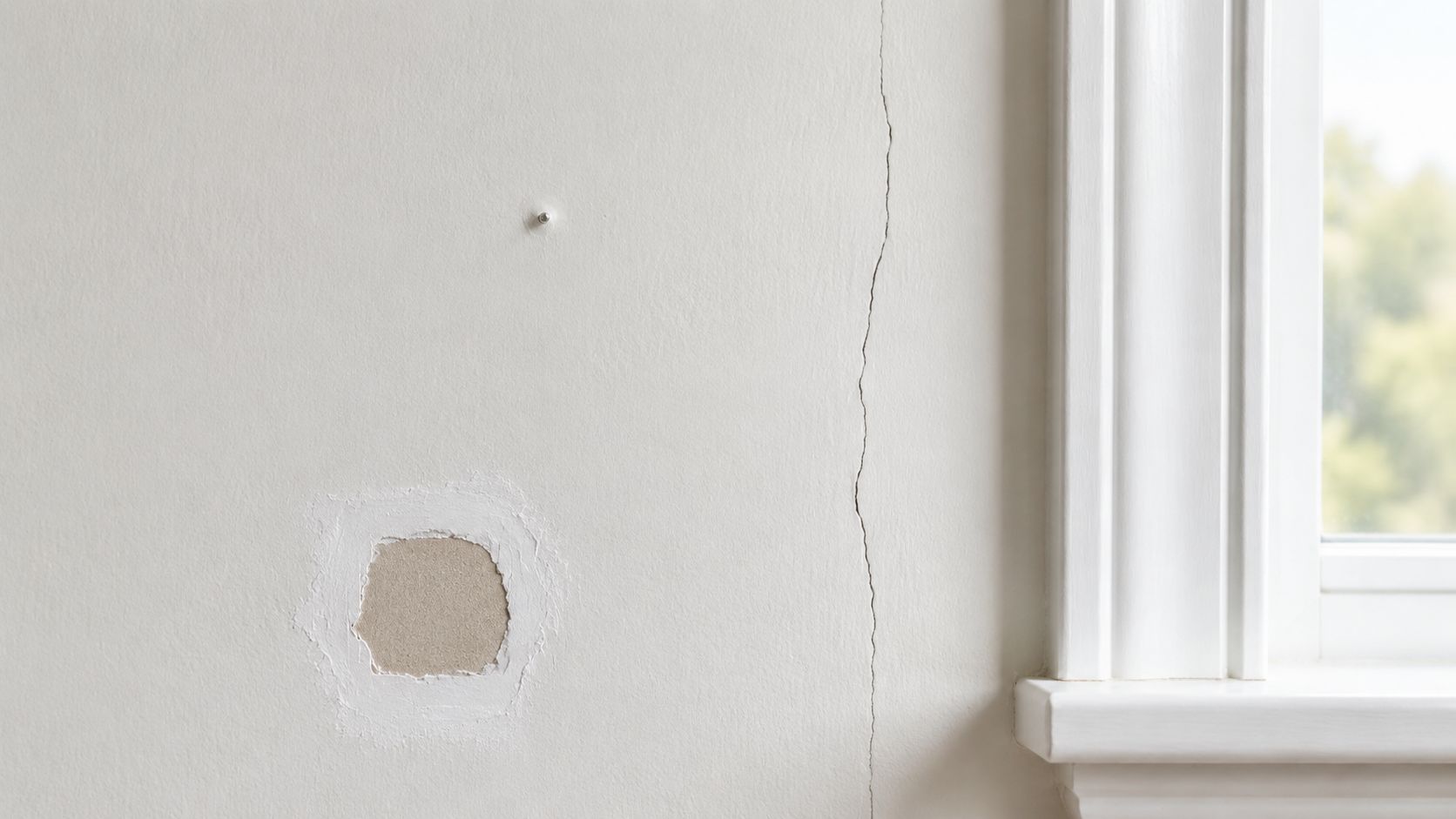
Small surface damage
Minor dents, anchor holes, nail pops, and scuffs are the easiest category. These are usually cosmetic unless they show a repeated movement issue underneath. A proper repair still needs filling, sanding, and surface blending so the touch-up paint doesn't telegraph the patch.
For landlords and property managers, it also helps to understand the difference between routine use and actual damage. This guide for property investors on wear offers a useful framework for thinking through normal wear versus repairs that should be addressed before a unit turns over.
Cracks that need a closer look
Hairline cracks can come from normal settling, seasonal movement, or weak prior repairs. Wider or repeating cracks deserve more attention, especially around door corners, stair-step transitions, or ceiling-to-wall joints.
What matters isn't just filling the line. The repair has to stabilize the area, reinforce it where needed, and feather the finish far enough beyond the crack so it disappears after paint.
Some recurring cracks aren't patching problems. They're movement problems that show up through the drywall.
Water damage changes the repair plan
In Lake Oswego and similar Pacific Northwest conditions, moisture-driven deterioration is the main technical problem behind failed drywall repairs. Proper work means fixing the leak source, removing compromised material, and confirming the area is dry before any patching, as described in this Lake Oswego drywall patch and repair guidance.
That matters because wet gypsum loses strength. The paper face can delaminate, the core can soften, and staining may be the least important part of the problem. Cosmetic skim coating over water-damaged drywall often looks fine briefly, then bubbles, sags, or stains again.
Common signs that point to a larger repair include:
- Soft drywall: The surface gives under light pressure.
- Sagging ceiling texture: A sign the board may have absorbed water.
- Brown or yellow staining: Often indicates prior or ongoing moisture.
- Musty smell: Suggests the cavity may need closer inspection.
- Crumbling edges around a hole: Means the surrounding board may not hold a clean patch well.
When moisture is involved, the right first question isn't “How do I hide this?” It's “Why did this happen, and is the board still sound?”
DIY Repair vs Hiring a Professional Contractor
A drywall repair can look simple at 6 p.m. After the first coat dries, the patch shrinks, the edges flash under light, and the wall suddenly needs more skill than expected. That is the point where many Lake Oswego homeowners decide whether they want a decent patch or a finish that disappears once the room is painted and the windows are throwing side light across the wall.
DIY makes sense in the right situation. Professional repair makes sense sooner than many people expect, especially in higher-end homes where smooth walls, ceiling lines, and texture consistency are easy to judge from across the room.
When DIY is reasonable
Handle it yourself when the repair is small, low-risk, and in a spot that does not demand perfect finish work. Good examples include:
- Small nail or screw holes
- Minor dents in a closet, garage, or utility space
- Light touch-up work before repainting a low-visibility wall
- Very small surface damage where a slight variation will not bother you
The trade-off is finish quality. Filling a hole is usually the easy part. Getting the surface flat, sanding it cleanly, and keeping it from showing through paint takes more control than many homeowners expect.
If you have weighed similar finish decisions in other parts of the house, the same logic shows up in this DIY vs professional wood floor repair discussion. Surface repairs often start small, but the final appearance is what separates a quick fix from work that holds up visually.
When hiring a pro is the better call
Professional drywall repair usually pays off when the repair sits in a visible room, involves a ceiling, or needs to match an existing finish precisely. In Lake Oswego, that matters because many homes have larger windows, cleaner wall lines, and higher expectations for paint-ready surfaces.
Hiring out is usually the smarter choice for:
- Ceiling repairs
- Water-damaged areas after the source issue has been corrected
- Large cut-outs from plumbing or electrical access
- Recurring cracks
- Orange peel, knockdown, or hand-applied texture matching
- Smooth-wall rooms with strong natural light
- Pre-sale touch-ups where appearance affects first impressions
- Level 5 finish work where flaws show immediately after paint
A so-called simple patch can turn into a finish problem fast. I see that most often on smooth walls and ceilings. The board repair itself may be straightforward, but getting the surface uniformly flat, controlling dust, and blending the repaired area so it does not show through primer and paint is where experience matters.
For homeowners who want help with that scope, drywall repair services are one route, and the same contractor may also handle related interior work if the project expands.
| Factor | DIY Repair | Professional Repair (CS1 Interiors) |
|---|---|---|
| Cost control | Lower upfront if the patch is truly small | Better value when the repair needs blending, texture matching, or prep for painting |
| Time | Often spread over several rounds of drying, sanding, and re-coating | Scheduled as a defined repair process with less homeowner time involved |
| Tools and materials | Requires knives, compound, sanding supplies, patch material, and dust control | Includes the needed tools, materials, and finish process |
| Finish quality | Acceptable in low-visibility areas | Better for smooth walls, ceilings, texture match, and Level 4 or Level 5 expectations |
| Risk of rework | Higher if the patch shrinks, flashes, cracks, or shows under paint | Lower when the repair method fits the actual damage |
| Best fit | Tiny cosmetic fixes | Visible rooms, ceilings, larger openings, texture matching, and resale prep |
The most expensive drywall repair is usually the one that gets patched twice.
Get Your Free Drywall Repair Estimate
A quick estimate can save a homeowner from choosing the wrong repair scope.
In Lake Oswego, that matters most when the damage looks minor but sits in a visible area. A small ceiling stain, a cracked corner, or a patch on a smooth wall can turn into a paint and finish problem if the surface needs to disappear under natural light. That is usually the point where a simple repair stops being simple.
A useful estimate should clarify three things. Whether the drywall is structurally sound around the damaged area, what level of finish the repair needs, and how much work is required to match the surrounding surface. On higher-end homes, Level 5 expectations and texture blending often drive the labor more than the patch itself.
That clarity helps with real decisions. Some homeowners are getting a room ready for paint. Others are preparing for a sale, wrapping up a remodel, or fixing damage before it gets worse. A professional estimate gives you a realistic scope before you commit time, money, and disruption inside the house.
The CS1 Professional Repair Process Explained
A quality drywall repair is usually won or lost before the first coat of compound goes on. Preparation, clean cut lines, stable backing, and surface protection make the finish stage much easier and much cleaner.
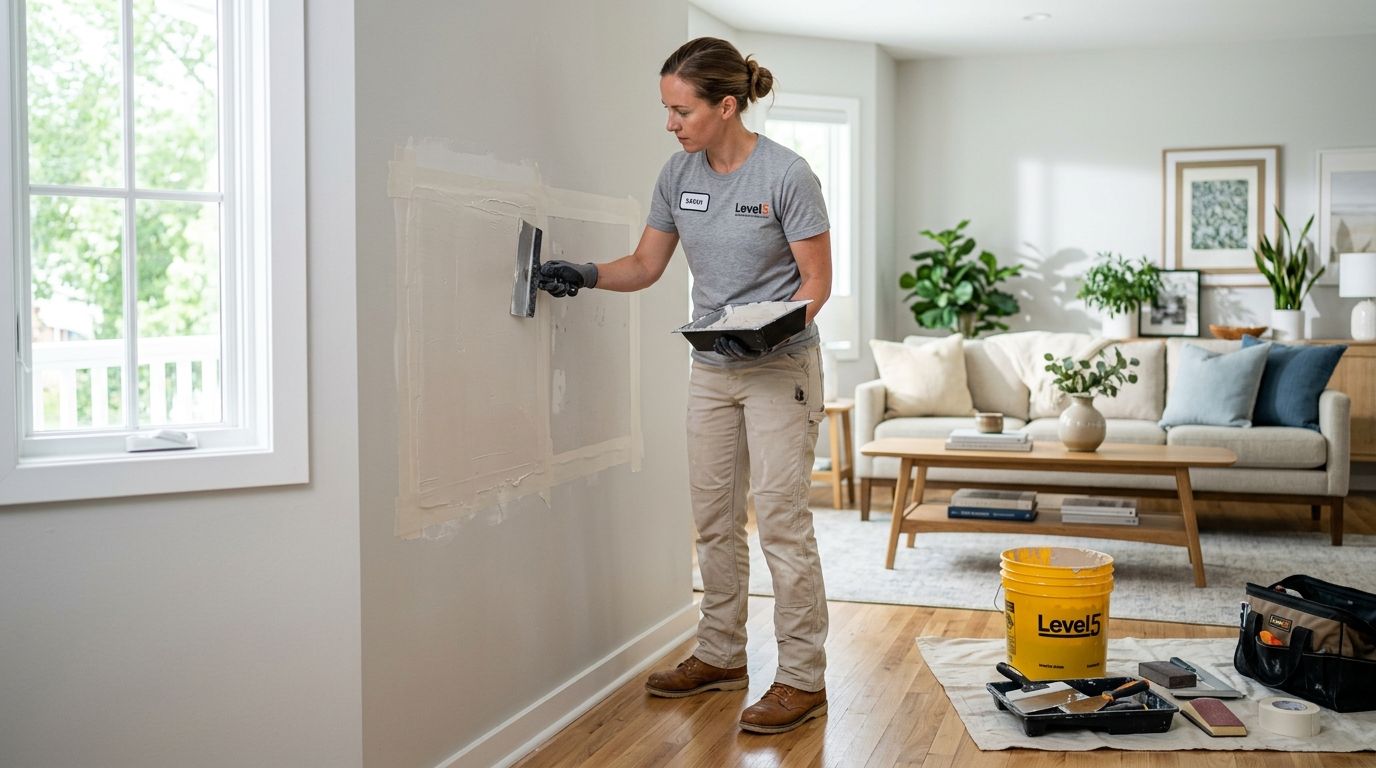
What happens before the patch goes in
The first step is assessing the actual boundary of the damage. That means checking whether the problem is limited to the visible surface or whether the surrounding board has weakened, shifted, or absorbed moisture. A clean repair starts with removing all material that won't hold a lasting finish.
Then the work area gets protected. Floors, nearby furniture, and adjacent finishes need containment because drywall dust travels easily. On occupied homes, that part matters almost as much as the repair itself.
A standard sequence often looks like this:
- Protect the space: Cover floors, isolate dust, and create a clean work zone.
- Cut back to sound drywall: Remove loose, stained, soft, or broken material.
- Install backing and patch material: Fit the replacement piece so the surface stays stable.
- Tape the joints: Reinforce seams to reduce the chance of visible cracking.
- Build the finish in coats: Let each coat set before the next one is applied.
Good drywall work is usually patient work. The surface gets flatter because each step is controlled, not because more mud was added.
How the finish becomes paint ready
The finish stage is where patching turns into actual restoration. Joint compound has to be applied in a way that widens the transition gradually so the repair disappears into the field of the wall or ceiling. On smooth walls, that feathering has to be especially clean.
Level 4 work is common for many painted interiors. Level 5 matters more when walls are very smooth, lighting is unforgiving, or the homeowner wants a more refined finish. That extra attention reduces visible surface variation and makes the room look more consistent once painted.
Texture matching is its own skill. Orange peel, knockdown, and hand-applied textures all need pattern control, not just material on the wall. If the pattern is off, the eye finds the patch immediately.
This short video gives a useful look at hands-on drywall repair technique and why finish control matters:
The last step is surface review and cleanup. A proper repair should be ready for primer and paint, with the work area left clean enough that the homeowner isn't dealing with dust long after the contractor leaves.
Costs and Timelines for Drywall Repair in Lake Oswego
Price questions usually come down to one thing. Homeowners want to know why a “small” patch can still carry a meaningful labor cost. In Lake Oswego, the answer is usually finish work.
Published local pricing data shows drywall work in Lake Oswego at $2 to $4 per square foot in 2026, and it notes local labor rates are about 10% above the national average, based on BLS-modeled cost data in this Lake Oswego drywall cost reference. That fits what homeowners see in real estimates. Materials aren't usually the biggest factor. Labor, setup, finish quality, and scope drive the price.
What affects the price
A few things change the number quickly:
- Repair size: Larger openings need more cutting, backing, board replacement, and finishing area.
- Wall or ceiling location: Ceilings are slower to repair and harder to blend cleanly.
- Access conditions: Stairwells, tight corners, high walls, and occupied rooms add setup time.
- Finish expectations: A utility-room patch and a main-level smooth-wall repair are not the same job.
- Texture and paint readiness: Matching existing texture or delivering a high-end smooth surface takes more labor.
For Lake Oswego homes, this trade-off matters. If the repair is in a visible room, the cheapest scope isn't always the most economical result. A slightly larger repair area often gives a cleaner final finish than trying to keep the patch as tiny as possible.
Why good repairs take more than one visit
Homeowners also ask why drywall repair can take longer than expected. The reason is drying and sequencing. A clean finish usually takes multiple compound applications, with sanding and inspection between coats.
That doesn't mean crews are dragging the job out. It means the surface is being built correctly. If the area is painted too soon or the finish is rushed, shrinkage, flashing, and visible seams are much more likely.
A realistic timeline depends on:
- How many coats the repair needs
- Whether the texture has to be matched
- Whether painting is included after the patch
- Whether the damage involved opening the wall further to correct underlying issues
For homeowners in Portland, Lake Oswego, Beaverton, and surrounding cities, the best estimate is always based on seeing the actual wall, not guessing from the hole size alone.
Your Drywall Repair Questions Answered
A few questions come up on almost every drywall repair call, especially when the damage involves ceilings, leaks, or pre-sale prep.
Do I need a permit for drywall repair in Lake Oswego
Usually, a simple patch doesn't need one. But Lake Oswego requires permits for new construction and alterations, with exceptions, so drywall work tied to water damage, insulation, or structural changes may need confirmation through the city, according to the city's building FAQ for permit questions.
If the repair happened because a wall was opened for plumbing, electrical, framing, or hidden moisture issues, don't assume it's just a patch job. Ask before work starts.
Can you match existing wall and ceiling texture
Yes, but some textures are easier to blend than others. Light orange peel is different from heavy knockdown. Older hand-applied finishes can also vary from room to room. The key is treating texture as part of the repair, not an afterthought after the patch is already flat.
When homeowners want the cleanest result, it also helps to pair drywall work with repainting the affected area or even the full wall plane. That's one reason many interior contractors handle both drywall and interior painting services on the same project.
Are ceiling repairs harder than wall repairs
Most of the time, yes. Gravity works against the patch, setup takes longer, and lighting makes flaws easier to see. Ceiling texture can also be harder to blend because homeowners usually look at it from multiple angles across the room.

If you're dealing with drywall repair in Lake Oswego, the right fix depends on more than the hole or crack itself. Moisture history, finish expectations, lighting, texture, and the room's purpose all affect the scope. A repair that looks fine in a garage can look obvious in a living room. That's why careful diagnosis and finish quality matter.
If you want a clean, paint-ready result for drywall damage in Lake Oswego, Portland, Beaverton, Hillsboro, Tigard, or nearby areas, contact CS1 Real Interiors and request a free estimate through the online contact form. Whether you need drywall repair, installation, interior painting, insulation, or metal stud framing, professional help can save time, reduce rework, and leave the room looking finished instead of patched.


